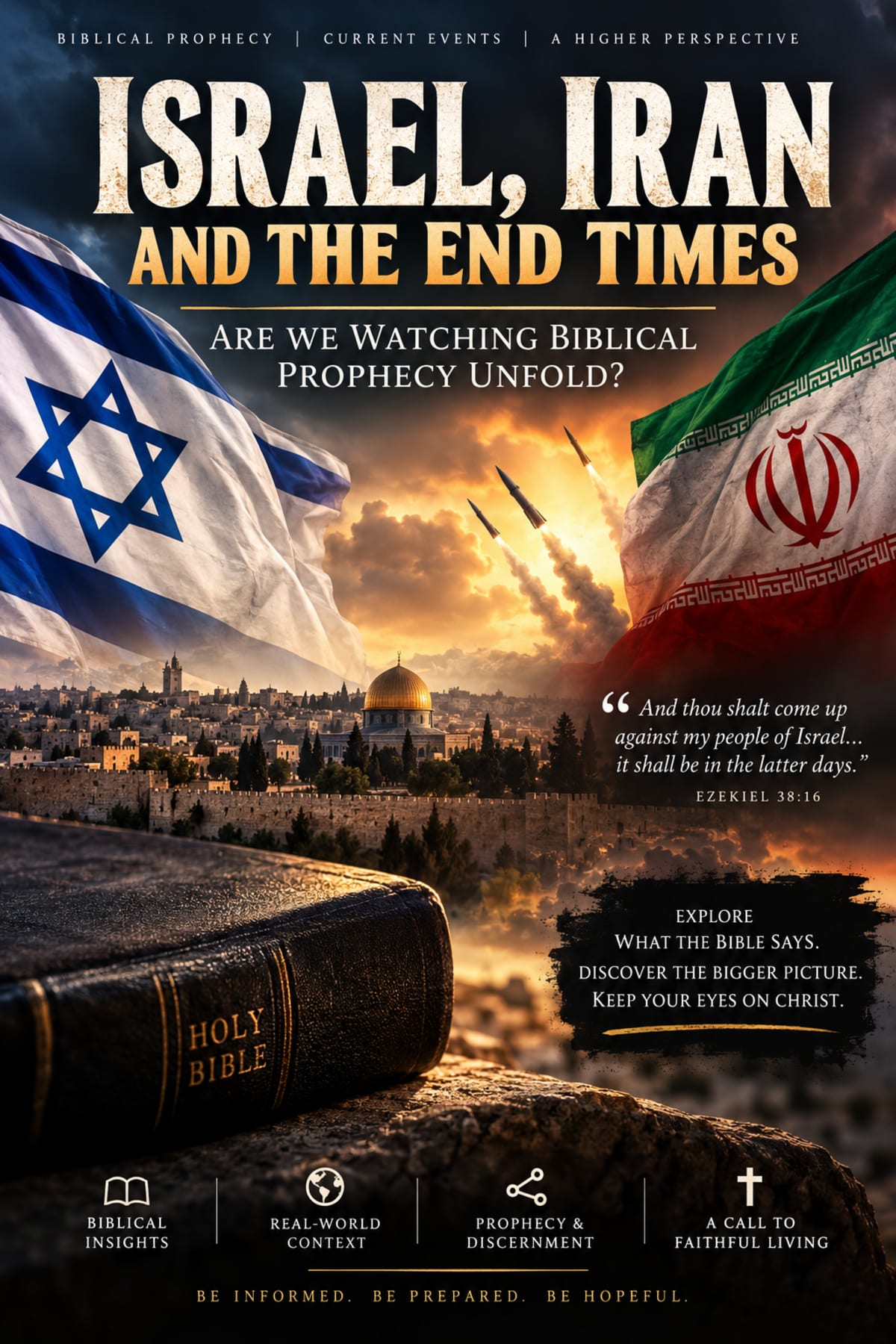
Israel, Iran, and the End Times: Are We Watching Biblical Prophecy Unfold?
By César Castro — A Voice in the Desert
What if the conflict shaking the Middle East is more than another chapter in a centuries-old geopolitical struggle? What if the names appearing in today’s headlines are causing Christians around the world to reopen prophecies written thousands of years ago?
Israel and Iran stand at the center of one of the most consequential rivalries in the modern Middle East. But for students of biblical prophecy, there is another reason this confrontation demands careful attention: modern Iran occupies the heartland of ancient Persia, and Persia is specifically named in one of the Bible’s most remarkable prophecies concerning a future attack against Israel.
Ezekiel wrote:
“Persia, Ethiopia, and Libya with them; all of them with shield and helmet.”
— Ezekiel 38:5
That alone should cause the serious student of Scripture to pay attention.
But we must begin with an important warning.
The Bible does not explicitly say, “A modern war between the State of Israel and the Islamic Republic of Iran fulfills Ezekiel 38.” We must never make Scripture say more than Scripture actually says.
Jesus warned:
“And ye shall hear of wars and rumours of wars: see that ye be not troubled… but the end is not yet.”
— Matthew 24:6
Therefore, our purpose is not to sensationalize headlines or set dates for Christ’s return.
Our purpose is to ask a more responsible question:
Could the circumstances developing around Israel, Iran, Jerusalem, and the nations resemble elements of the prophetic landscape Scripture tells believers to watch?
To answer that question, we must open our Bibles.
1. Persia Appears in Biblical Prophecy
Long before the modern nation of Iran existed under its present name, the Bible spoke extensively about Persia.
Persia was not always Israel’s enemy.
In fact, one of the great figures of biblical history was the Persian king Cyrus.
After the Babylonian captivity, Cyrus permitted the Jewish people to return to Jerusalem and rebuild the temple. Remarkably, Isaiah mentioned Cyrus by name long before these events occurred:
“Thus saith the LORD to his anointed, to Cyrus, whose right hand I have holden…”
— Isaiah 45:1
The books of Ezra, Nehemiah, Esther, and Daniel also place Persia prominently within biblical history.
But Persia appears in another context that is especially important when discussing the last days.
Ezekiel 38 describes a mysterious leader called Gog, from the land of Magog, leading a coalition of nations against Israel.
Among those nations is Persia:
“Persia, Ethiopia, and Libya with them…”
— Ezekiel 38:5
The connection with modern Iran deserves attention because Persia was the internationally recognized name associated with Iran until the twentieth century.
But attention is not the same thing as certainty.
The presence of Persia in Ezekiel’s prophecy does not automatically mean that every conflict between modern Iran and Israel is Ezekiel 38.
It means Persia’s presence in the prophecy is significant enough that Christians should study it carefully.
2. The Mysterious War of Ezekiel 38–39
Ezekiel’s prophecy is extraordinary.
The prophet describes Gog assembling a multinational coalition and moving against Israel:
“And thou shalt come from thy place out of the north parts, thou, and many people with thee… a mighty army.”
— Ezekiel 38:15
Then Scripture tells us something particularly important about the timing:
“And thou shalt come up against my people of Israel… it shall be in the latter days.”
— Ezekiel 38:16
Notice those words:
“The latter days.”
This is one reason Ezekiel 38 has fascinated generations of prophecy scholars.
The prophecy concerns Israel dwelling in the land and a coalition gathering against her.
Yet the decisive factor in Ezekiel’s account is not ultimately Israeli military power.
God Himself intervenes.
The Lord declares:
“And it shall come to pass at the same time when Gog shall come against the land of Israel… that my fury shall come up in my face.”
— Ezekiel 38:18
Ezekiel describes an enormous earthquake:
“Surely in that day there shall be a great shaking in the land of Israel.”
— Ezekiel 38:19
Confusion then falls upon the invading forces:
“Every man’s sword shall be against his brother.”
— Ezekiel 38:21
And divine judgment follows:
“And I will plead against him with pestilence and with blood; and I will rain upon him… an overflowing rain, and great hailstones, fire, and brimstone.”
— Ezekiel 38:22
Why does God intervene?
God Himself provides the answer:
“Thus will I magnify myself, and sanctify myself; and I will be known in the eyes of many nations, and they shall know that I am the LORD.”
— Ezekiel 38:23
This prophecy is therefore not primarily about military strategy.
It is about the sovereignty of God.
3. Has Ezekiel 38 Already Begun?
This is where Christians must exercise discernment.
Some prophecy teachers see developments involving Israel, Iran and other regional or global powers and immediately declare:
“Ezekiel 38 is happening right now.”
That conclusion goes beyond what we can establish with certainty.
There are significant debates among faithful Bible interpreters concerning the identities of Gog, Magog, Meshech, Tubal, Gomer and Togarmah.
There is also disagreement about when Ezekiel’s battle occurs.
Various interpreters place it:
before the Tribulation,
near the beginning of the Tribulation,
during the Tribulation,
near Christ’s return,
or in relationship to the events described in Revelation 20.
These interpretations cannot all be correct simultaneously.
Therefore humility is necessary.
We can recognize similarities without declaring fulfillment prematurely.
There is a major difference between saying:
“This fulfills Ezekiel 38.”
and saying:
“These developments make Ezekiel 38 increasingly important for Christians to understand.”
The second statement is far more responsible.
4. Daniel Reveals a Spiritual Dimension Behind Persia
Persia appears elsewhere in prophecy, and Daniel gives us an extraordinary glimpse into something occurring beyond human politics.
Daniel had been praying when an angelic messenger finally arrived.
The messenger explained:
“But the prince of the kingdom of Persia withstood me one and twenty days: but, lo, Michael, one of the chief princes, came to help me…”
— Daniel 10:13
This “prince of Persia” was apparently not merely a human ruler. The context describes spiritual conflict involving supernatural beings.
Later the messenger says:
“Now will I return to fight with the prince of Persia: and when I am gone forth, lo, the prince of Grecia shall come.”
— Daniel 10:20
Daniel reveals an important biblical principle:
Behind the visible movements of earthly kingdoms, Scripture sometimes reveals an invisible spiritual conflict.
Paul similarly reminds believers:
“For we wrestle not against flesh and blood, but against principalities, against powers… against spiritual wickedness in high places.”
— Ephesians 6:12
That does not mean every political disagreement should be labeled demonic.
Nor should Christians demonize entire ethnic groups or national populations.
The Iranian people are human beings made in God’s image, just as Israelis, Arabs, Americans and every other people are.
Our enemy is not flesh and blood.
That distinction matters greatly.
5. Israel and the Prophetic Clock
Few subjects generate more controversy in prophecy discussions than Israel.
Has God completely finished with national Israel?
Or does Israel still have a future role within God’s prophetic purposes?
Paul addressed this question directly:
“Hath God cast away his people? God forbid.”
— Romans 11:1
Later he writes:
“For I would not, brethren, that ye should be ignorant of this mystery… that blindness in part is happened to Israel, until the fulness of the Gentiles be come in.”
— Romans 11:25
Then:
“And so all Israel shall be saved…”
— Romans 11:26
Christians disagree about some aspects of how these passages should be interpreted, but Romans 11 makes one point exceedingly difficult to dismiss:
God has not forgotten Israel.
Paul declares:
“For the gifts and calling of God are without repentance.”
— Romans 11:29
This is one reason developments surrounding Israel continually attract the attention of students of prophecy.
6. Jerusalem: A City at the Center of Prophecy
There may be no city on earth with greater prophetic significance in Scripture than Jerusalem.
Zechariah declared:
“Behold, I will make Jerusalem a cup of trembling unto all the people round about…”
— Zechariah 12:2
Then:
“And in that day will I make Jerusalem a burdensome stone for all people…”
— Zechariah 12:3
Later the prophet describes a climactic confrontation:
“For I will gather all nations against Jerusalem to battle…”
— Zechariah 14:2
And then something astonishing happens:
“Then shall the LORD go forth, and fight against those nations…”
— Zechariah 14:3
The prophecy continues:
“And his feet shall stand in that day upon the mount of Olives, which is before Jerusalem on the east…”
— Zechariah 14:4
Jerusalem therefore occupies an extraordinary position in biblical eschatology.
This does not mean every political dispute involving Jerusalem fulfills Zechariah.
But it does mean that when the Bible speaks about the culmination of history, Jerusalem repeatedly appears in the story.
7. Jesus Warned About Wars and Rumors of Wars
When Jesus’ disciples asked Him about the end of the age, Christ gave one of Scripture’s most important prophetic teachings.
He said:
“And ye shall hear of wars and rumours of wars: see that ye be not troubled…”
— Matthew 24:6
Notice the command:
“See that ye be not troubled.”
Jesus did not teach prophecy so His followers would panic.
He taught prophecy so His followers would remain faithful.
Christ continued:
“For nation shall rise against nation, and kingdom against kingdom: and there shall be famines, and pestilences, and earthquakes, in divers places.”
— Matthew 24:7
Then Jesus adds an important qualification:
“All these are the beginning of sorrows.”
— Matthew 24:8
Wars alone do not prove that the Second Coming will occur tomorrow.
Human history has witnessed devastating wars for centuries.
Jesus specifically said:
“But the end is not yet.”
— Matthew 24:6
That single phrase should protect the Church from sensationalism.
8. The Danger of Newspaper Prophecy
Every generation has been tempted to take current political figures and force them into biblical prophecy.
Christians have identified various emperors, dictators, presidents and political leaders as the Antichrist.
Dates have repeatedly been predicted for Christ’s return.
Those dates came and went.
Jesus said:
“But of that day and hour knoweth no man…”
— Matthew 24:36
Therefore we must distinguish between watchfulness and speculation.
Watchfulness says:
“Christ could return. I must live faithfully.”
Speculation says:
“I have decoded the exact timetable.”
Scripture commands the first.
It warns us against the arrogance behind the second.
9. Is the Israel-Iran Conflict Armageddon?
Not automatically.
Revelation describes a climactic gathering associated with a place called Armageddon:
“And he gathered them together into a place called in the Hebrew tongue Armageddon.”
— Revelation 16:16
Revelation 19 then portrays the return of Christ in unmistakably dramatic language:
“And I saw heaven opened, and behold a white horse; and he that sat upon him was called Faithful and True…”
— Revelation 19:11
John later writes:
“And I saw the beast, and the kings of the earth, and their armies, gathered together…”
— Revelation 19:19
Whatever one’s detailed eschatological framework, Revelation portrays something far larger than an ordinary regional military confrontation.
We should therefore be extremely careful before labeling any present conflict “Armageddon.”
10. What About Gog and Magog?
Ezekiel 38 introduces:
“Gog, the land of Magog, the chief prince of Meshech and Tubal.”
— Ezekiel 38:2
Much speculation surrounds these names.
Some teachers confidently identify specific modern countries with every ancient name.
But ancient geography, changing borders, migrations and linguistic questions make some identifications more complicated than popular prophecy charts sometimes suggest.
One identification, however, is considerably clearer:
Persia is historically connected with Iran.
This makes Iran’s appearance within discussions of Ezekiel 38 understandable.
But even here we must remember:
Recognizing Persia does not automatically identify every other member of Ezekiel’s coalition or prove that the prophecy has begun.
11. The Real Message of Ezekiel 38 Is Often Missed
People frequently study Ezekiel 38 asking:
Who is Russia?
Who is Turkey?
Who is Iran?
When will the invasion happen?
What weapons will they use?
Those questions may be interesting.
But they can cause us to miss the theological center of the chapter.
God says:
“Thus will I magnify myself, and sanctify myself…”
— Ezekiel 38:23
The central figure of Ezekiel 38 is not Gog.
It is not Persia.
It is not Israel.
It is God.
The nations move.
Armies gather.
Leaders strategize.
But God remains sovereign.
Psalm 2 asks:
“Why do the heathen rage, and the people imagine a vain thing?”
— Psalm 2:1
Kings may make plans, but heaven is not nervous.
God has not lost control of history.
12. Prophecy Should Produce Holiness, Not Fear
This may be the most important part of this entire discussion.
Why did God reveal future events?
Was it so Christians could spend their lives terrified by every breaking-news notification?
No.
Biblical prophecy should produce holiness, urgency, faithfulness and hope.
Peter writes:
“Seeing then that all these things shall be dissolved, what manner of persons ought ye to be in all holy conversation and godliness.”
— 2 Peter 3:11
Notice Peter’s emphasis.
He does not merely ask:
“Do you understand prophecy?”
He essentially asks:
“How are you living because you understand prophecy?”
That is the question the Church desperately needs to hear.
You may understand Daniel’s seventy weeks.
You may have memorized Revelation.
You may know every interpretation of Ezekiel 38.
But are you walking with Christ?
Are you forgiving?
Are you praying?
Are you sharing the Gospel?
Are you living in holiness?
Are you ready to meet your King?
13. Do Not Fear What Is Coming
Jesus warned His disciples about terrible events.
Yet His message was never one of hopelessness.
He said:
“See that ye be not troubled.”
— Matthew 24:6
Why?
Because the Christian understands something the world does not.
History is not moving toward chaos without purpose.
History is moving toward Christ.
The final chapter does not belong to Iran.
It does not belong to Israel.
It does not belong to Russia, China, America or any other earthly power.
It belongs to Jesus Christ.
Revelation declares:
“The kingdoms of this world are become the kingdoms of our Lord, and of his Christ; and he shall reign for ever and ever.”
— Revelation 11:15
That is where biblical prophecy ultimately leads.
Not to fear.
To a throne.
14. Christians Must Pray for Israelis and Iranians
There is another danger in prophecy discussions.
We can become so fascinated with nations on prophetic charts that we forget the human beings living inside those nations.
There are Israelis who need Christ.
There are Iranians who need Christ.
There are Palestinians who need Christ.
There are Arabs, Persians and Jews who desperately need the Gospel.
Jesus commanded:
“Love your enemies, bless them that curse you, do good to them that hate you, and pray for them…”
— Matthew 5:44
Our theology of the end times should never eliminate our compassion.
Political governments make decisions.
Military commanders issue orders.
But ordinary families suffer when missiles fall.
Children cry.
Parents grieve.
Homes disappear.
The Church must never celebrate human suffering simply because we believe an event may have prophetic significance.
Prophecy without compassion becomes cold theology.
Jesus wept over Jerusalem.
So should our hearts remain tender toward people caught in war.
15. Watch Israel—but Watch Christ More
Israel deserves attention when studying biblical prophecy.
Jerusalem deserves attention.
Iran deserves attention because of Persia’s biblical significance.
But Christians can become so obsessed with watching nations that they stop watching Jesus.
Christ said:
“Watch therefore: for ye know not what hour your Lord doth come.”
— Matthew 24:42
The purpose of watching prophecy is ultimately to watch for Christ.
Jesus gave another warning:
“Therefore be ye also ready: for in such an hour as ye think not the Son of man cometh.”
— Matthew 24:44
The greatest prophetic question is therefore not:
“When will Iran attack Israel?”
It is not:
“Who exactly is Gog?”
It is not even:
“When will the Tribulation begin?”
The greatest question is:
Are you ready to meet Jesus Christ?
16. The Gospel Must Remain at the Center
Prophecy without the Gospel is incomplete.
Jesus did not merely tell His disciples that difficult times would come.
He also declared:
“And this gospel of the kingdom shall be preached in all the world for a witness unto all nations; and then shall the end come.”
— Matthew 24:14
The mission of the Church has not changed.
Preach Christ.
Make disciples.
Call sinners to repentance.
Care for the hurting.
Stand for truth.
Walk in holiness.
Remain faithful.
While the world watches missiles, armies, elections and alliances, the Church must continue proclaiming:
Jesus Christ saves.
17. Could We Be Watching the Prophetic Stage Being Prepared?
Here we must answer carefully.
Possibly.
But Scripture does not authorize us to declare every current event a direct fulfillment.
The existence of Israel in the land, Jerusalem’s continuing international importance, Iran’s hostility toward Israel, and Persia’s presence in Ezekiel 38 certainly make these biblical passages worthy of renewed study.
But Christians should resist the temptation to transform possibility into certainty.
We should say:
“This is worth watching.”
We should not say:
“God told us this specific headline fulfills this specific prophecy,”
unless Scripture unmistakably establishes it.
Paul wrote:
“Prove all things; hold fast that which is good.”
— 1 Thessalonians 5:21
Biblical discernment requires both an open Bible and a humble heart.
18. When You Hear of War, Remember Who Is King
Perhaps tonight you are watching reports from the Middle East.
Perhaps you see missiles crossing the sky.
Perhaps you hear politicians threatening retaliation.
Perhaps you wonder:
How much worse can this become?
Remember something.
Jesus already told His Church that turbulent times would come.
He also told us how to respond:
“See that ye be not troubled.”
— Matthew 24:6
Our confidence is not based upon peaceful governments.
Our confidence is not based upon diplomatic agreements.
Our confidence is not based upon military superiority.
Our confidence is in Jesus Christ.
He is still Lord when nations rage.
He is still Lord when governments collapse.
He is still Lord when armies gather.
He is still Lord when the headlines frighten us.
And He will still be Lord when every earthly kingdom has passed away.
Conclusion: The Headlines May Be Changing, but the Bible Has Not
Israel.
Iran.
Persia.
Jerusalem.
Gog.
Magog.
Wars.
Rumors of wars.
The nations gathering.
These words immediately capture our attention because Scripture speaks about them—or about related prophetic realities—in passages concerning God’s purposes in history.
But biblical prophecy was never intended to turn Christians into frightened spectators.
It was intended to create faithful disciples.
The question is not merely whether we can identify Persia on a prophetic map.
The question is whether we recognize Christ as King.
The question is not merely whether Ezekiel 38 is approaching.
The question is whether our hearts are prepared for eternity.
The question is not merely:
“Are we living in the last days?”
The deeper question is:
“If Jesus came today, would you be ready?”
Christ said:
“Watch therefore: for ye know neither the day nor the hour wherein the Son of man cometh.”
— Matthew 25:13
Church, this is not the hour for fear.
This is not the hour for sensationalism.
This is not the hour for sleeping spiritually.
This is the hour to watch.
This is the hour to pray.
This is the hour to preach the Gospel.
This is the hour to live holy.
This is the hour to stand firm.
Because regardless of whether today’s conflict becomes tomorrow’s prophetic fulfillment, one truth remains absolutely certain:
Jesus Christ is coming again.
And when He comes, He will not come as the suffering servant walking toward Calvary.
He will come as King of kings and Lord of lords.
“And he hath on his vesture and on his thigh a name written, KING OF KINGS, AND LORD OF LORDS.”
— Revelation 19:16
So watch the Middle East.
Watch Jerusalem.
Study Ezekiel.
Study Daniel.
Study Revelation.
But above everything else—
Keep your eyes on Jesus.
For nations rise and nations fall.
Wars begin and wars end.
Leaders come and leaders go.
But the Word of our God shall stand for ever.
— Isaiah 40:8
César Castro
A Voice in the Desert