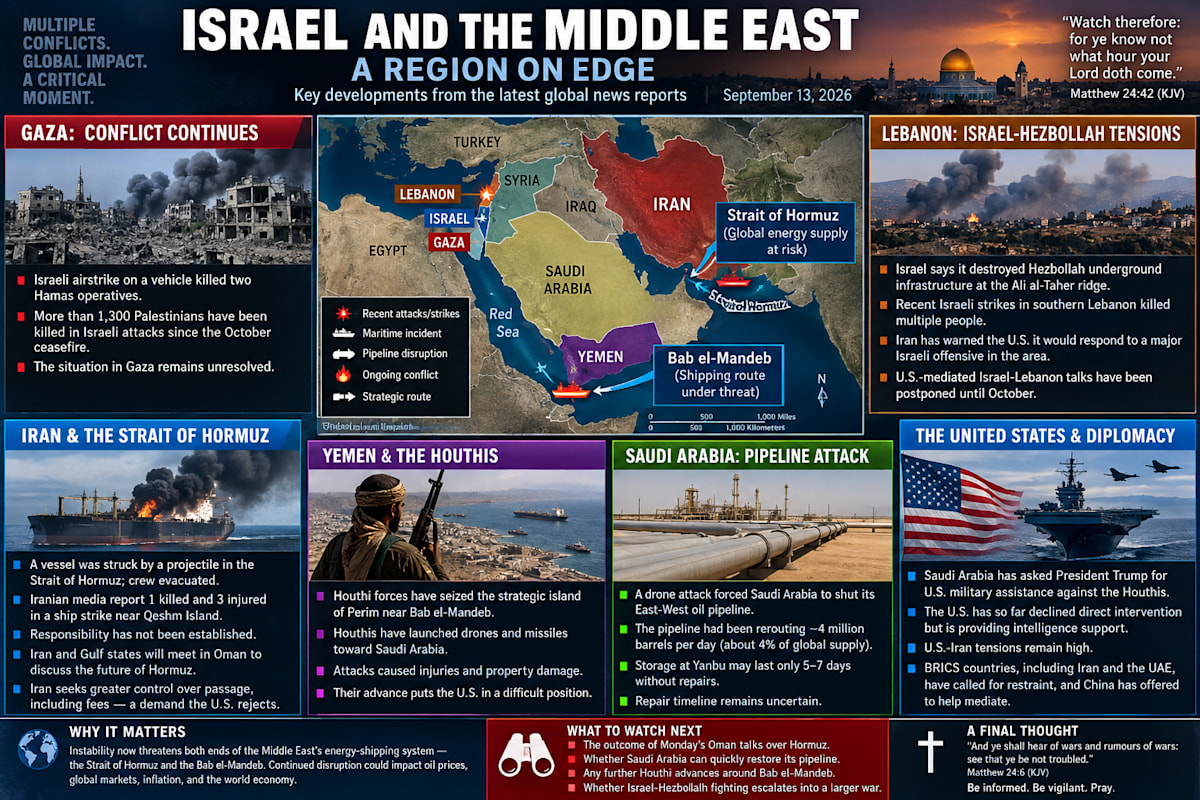
Current Events Report: Israel and the Middle East — September 13, 2026
The Middle East is experiencing a dangerous widening of conflict. What began as the Israel–Hamas war has evolved into a much broader regional confrontation involving Israel, Iran, Hezbollah in Lebanon, the Houthis in Yemen, Gulf states, and the United States. Based on reporting published today and over the past several days, the most consequential development is that threats now extend across both of the region’s critical maritime corridors—the Strait of Hormuz and the Bab el-Mandeb/Red Sea route.
Israel, Gaza and Hamas
Gaza remains an active front. The Associated Press reports today that an Israeli airstrike on a vehicle killed two Hamas operatives. AP also reports that more than 1,300 Palestinians have been killed in Israeli attacks since the October ceasefire, illustrating that the ceasefire has not produced an end to lethal military activity.
The Gaza conflict therefore remains unresolved even while the center of gravity of the regional crisis has increasingly shifted toward Iran, Lebanon, Yemen and the strategic waterways surrounding the Arabian Peninsula.
Israel and Hezbollah: the Lebanese front
The Israeli-Hezbollah confrontation has also intensified. On September 10, Israel said its military destroyed Hezbollah underground infrastructure around the strategically important Ali al-Taher ridge in southern Lebanon.
Days earlier, Israeli strikes in southern Lebanon killed seven people according to Lebanon’s Health Ministry, and another series of strikes on September 7 reportedly killed 12, increasing fears of another major Israeli campaign in Lebanon.
Iran has directly warned Washington that it would respond forcefully to a major Israeli offensive against the Hezbollah position around the ridge.
Diplomacy is moving slowly. U.S.-mediated Israel-Lebanon discussions that had been expected this month have reportedly been postponed until October, while disagreements remain over Hezbollah’s disarmament and the future Israeli military presence in southern Lebanon.
This front matters because a major escalation between Israel and Hezbollah could draw Iran more directly into the confrontation.
Iran and the Strait of Hormuz
Perhaps the most globally significant development today is occurring around the Strait of Hormuz, through which enormous quantities of the world’s energy supplies normally move.
Reuters reports that a vessel was struck by a projectile while traveling through the strait today. A fire broke out and the crew had to be evacuated. Separately, Iranian state media reported that an Iranian commercial vessel was struck near Qeshm Island, killing one person and injuring three; it was not immediately clear whether the reports concerned the same incident. Responsibility has not been established.
The strait has already been severely disrupted by the broader war. Iran and Gulf states are scheduled to meet in Oman on Monday to discuss the future of Hormuz, but Reuters reports that Iranian officials are playing down expectations of an immediate breakthrough.
Iran reportedly wants recognition of greater control over passage through Hormuz, including the ability to collect fees from vessels—something Washington rejects.
Yemen and the Houthis: another dangerous front
The second maritime crisis is unfolding roughly 1,000 miles away at Bab el-Mandeb, the narrow entrance connecting the Red Sea to the Gulf of Aden.
Iran-aligned Houthi forces have recently made major advances along Yemen’s Red Sea coast and seized the strategically important island of Perim, located in the Bab el-Mandeb Strait.
The Houthis have also launched drones and missiles toward Saudi Arabia. AP reports attacks toward southern Saudi Arabia, including a military target and civilian areas, with injuries and property damage reported.
This creates an extraordinary strategic problem: instability is now threatening both ends of the Middle Eastern energy-shipping system—Hormuz to the east and Bab el-Mandeb/Red Sea to the west.
Saudi Arabia and the global oil crisis
One of today’s biggest developments concerns Saudi Arabia.
A drone attack forced Saudi Arabia to shut its major East-West oil pipeline, which carries crude across the Arabian Peninsula to the Red Sea port of Yanbu. Reuters reports that the pipeline has recently been rerouting roughly 4 million barrels per day—about 4% of global oil supply—because Hormuz has been severely disrupted.
Reuters reports that storage at Yanbu may be sufficient to maintain exports for only roughly five to seven days without the pipeline resuming operations. Estimates for repairs remain uncertain, ranging from relatively quick partial restoration to several weeks.
That is why this conflict is no longer merely a Middle Eastern security issue. Continued disruption could affect oil prices, diesel and gasoline costs, inflation, transportation and the global economy.
The United States
Washington faces increasingly difficult choices. Saudi Crown Prince Mohammed bin Salman reportedly asked President Trump for U.S. military assistance against the Houthis. According to Reuters, Washington has so far declined direct intervention against them while offering intelligence assistance.
At the same time, the wider U.S.-Iran confrontation remains unresolved. Reuters reported earlier this month that U.S.-Iran exchanges of attacks had renewed fears of a broader regional war.
Diplomatic efforts continue. BRICS countries—including Iran and the UAE—have backed a statement calling for restraint, while China has indicated willingness to help mediate.
What should we be watching now?
Four developments could determine where this goes next: Monday’s Oman talks over Hormuz; whether Saudi Arabia can quickly restore its East-West pipeline; whether the Houthi advance around Bab el-Mandeb continues; and whether Israel-Hezbollah fighting expands into another large-scale Lebanon campaign.
If several of those situations deteriorate simultaneously, the Middle East could move from multiple interconnected conflicts toward something much closer to a full regional war.
A biblical perspective
For Christians watching these events, it is important to distinguish between what the news establishes and what Scripture teaches. We should be very careful about declaring that every missile strike or diplomatic crisis directly fulfills a particular prophecy.
Jesus warned:
“And ye shall hear of wars and rumours of wars: see that ye be not troubled.” — Matthew 24:6 (KJV)
Notice that Christ’s instruction was not panic, but discernment.
Israel and Jerusalem certainly occupy an important place in biblical prophecy. Ezekiel 38–39, Zechariah 12–14, Daniel, Matthew 24 and Revelation contain passages Christians have long studied in relation to the nations, Israel and the events preceding Christ’s return. But responsible biblical interpretation requires us not to force today’s headlines into Scripture before events establish the connection.
The appropriate Christian response is therefore vigilance rather than sensationalism:
“Watch therefore: for ye know not what hour your Lord doth come.” — Matthew 24:42.
The present situation deserves close attention. Israel is confronting threats on multiple fronts, Iran remains at the center of the regional struggle, Hezbollah remains active in Lebanon, the Houthis are expanding their reach around the Red Sea, and two of the world’s most important maritime chokepoints are under extraordinary pressure.
For the Church, these are days to watch, pray, remain rooted in Scripture and proclaim Christ without fear.